




Curious facts about Kyiv-Pechersk Lavra
 Destructive processes in the Lavra Cave Hills
Do you know what triggered threatening destructive processes in the Lavra Cave Hills?
Pechersk Brethren and Lavra clergy appealed to the tsarist government in 1767 for financial assistance to fortify Holy Hills. They testified that those holy caves, mostly composed of sand, did not change in hundreds of years, and survived both inside and outside. That was God’s Providence, they believed. At the same time monks underlined that the state of the hills started deteriorating in 1740, when engineers gave a command to dig ditches for front gardens to be located on the hillsides and in the near proximity to the caves. They also added that those actions resulted in gradual degradation of the state of the surface layer of the hills’ forested zone that stayed untouched, uncut and stabilized for centuries.
Trees having been hacked down, the water started filling the above-mentioned ditches and suddenly caused considerable damage to the Theodosius cave. It happened in 1741. Later, those hills that have been left without roots of the former trees, started sliding down. Mostly sandy soil did not have its previous hard condition. Surface rainwater and underground well-springs added to the massive deterioration of its state. All this led to the “little by little” flowing and slumping of the cave hills that were moving towards the bank of the Dnieper River.
In addition to that, clock mechanism of the ecological catastrophe in the area of the cave hills above the Dnieper River, activated by the Russian military, could not been stopped until now, despite significant funds and efforts.
Natalia Lytvyn
Captions to the illustrations:
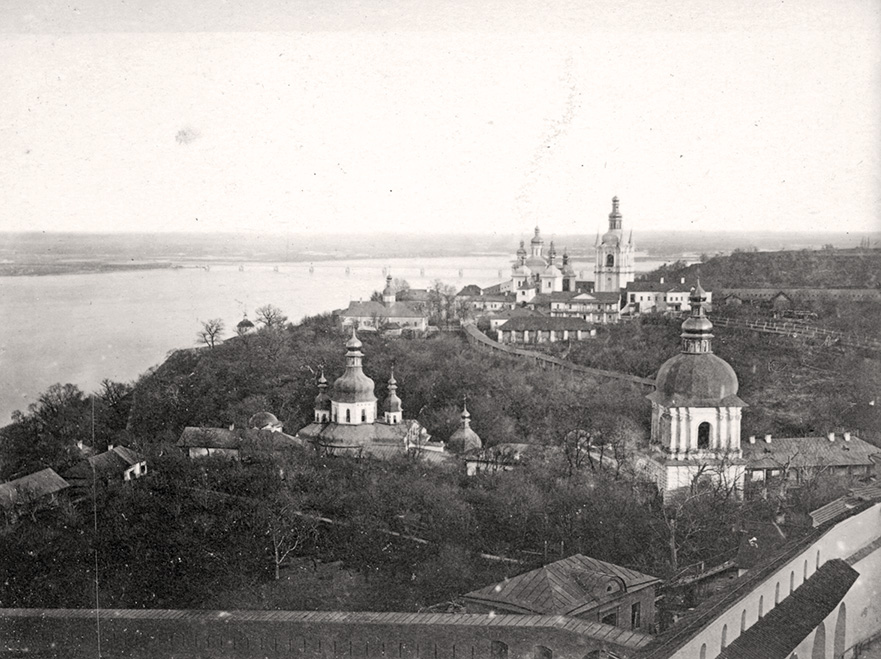
1. View of the architectural ensemble of the Near and Far Caves of Kyiv-Pechersk Lavra. The first third of the 20th century. [Scientific Archive of the Institute of Archeology, National Academy of Sciences of Ukraine, fund 10, file № 17]