Dear friends!
 Dear friends!
We continue to acquaint you with the Artistic Heritage of Kyiv-Pechersk Lavra.
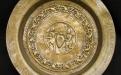
Today we are going to talk about an interesting work of decorative and applied art from the Fund collection of the Preserve. It is a tin dish that is adorned with “Messengers from Canaan” composition (KPL-M-7928).
Among the objects of material culture that are being stored in the National Preserve “Kyiv-Pechersk Lavra” there is the collection of the base metal ware of the 18th - early 20th centuries. Part of it is presented by the plates that are large in diameter, simple in shape and vary in the degree of depth. Some of these plates have engraved texts on their reverse side, and are known as “polumysok” (shallow bowls). Separate shallow bowls are marked by full or abbreviated names of churches and monasteries in which they were used.
Most often the only type of decoration that is used in such ware is a number of strips of simple ornament. They go along a wide edge of a dish. Yet, there are only a few pieces of ornamental dishes in the collection of the Preserve, which have images in their bottom. One of them deserves special attention.
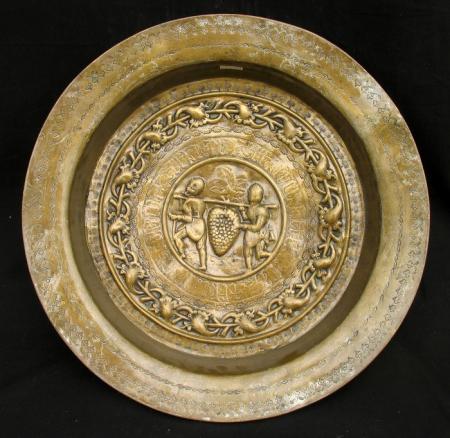
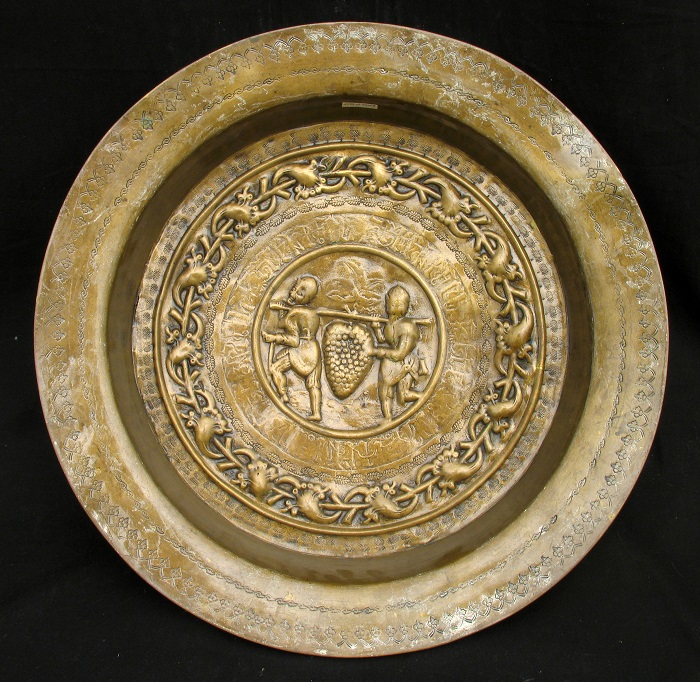
This is a tin shallow bowl, 52 cm in diameter. Its wide edge is decorated with two strips of exquisite engraved ornaments, while its bottom part is adorned with three different ornamental strips. One of them is a juicy spring braided with stylized pomegranate flowers. Around the frame of the central medallion there is an inscription in Gothic letters. Unfortunately, it cannot be read because most of the letters are badly erased. So it is perceived only as an ornament. The medallion depicts two men carrying a large bunch of grapes on a long pole. In the sacred art, the composition is called “Messengers from Canaan”. It is an extremely rare image on the metal objects used for religious purposes.
The composition is based on the biblical story of the Fourth Book of Moses (Num. 13). During his stay in the wilderness of Paran, the prophet Moses, sent 12 men (one man from every tribe of their fathers”) to inspect the land of Canaan. It was at the Lord’s command that promised that this land would belong to the children of Israel. When the messengers returned, they brought the fruits (pomegranates, figs, and a huge cluster of grapes, cut in the Eschol Valley) from the Land of Milk and Honey that proved its rich and fertile nature. (Num. 13:24).
This plot is one of the symbolic and allegorical images of the Eucharist topic, which was quite common in the sacred art of the 17th-18th centuries.
However, in comparison with other symbolic plots of the Eucharistic content, the one that speaks about the “Messengers from Canaan” is less common.
The tradition to consecrate fruit put in the elegant shallow bowls has always been one of the elements of the Feast of the Transfiguration of the Lordpopularly known as the Apple Savior. Once on this day, people dressed in white, took lush bouquets with pieces of rye or wheat and went to the church to sanctify everything that Mother Earth gave: apples, grapes, pears, peas, potatoes, cucumbers, tomatoes and more. The consecration of various fruits on this day symbolized the flowering and fertility of everything created in the Kingdom of life.
Captions to the illustrations:
1. Shallow bowl with “Messengers from Canaan” composition, 17th – 18th centuries [KPL-M-7928]
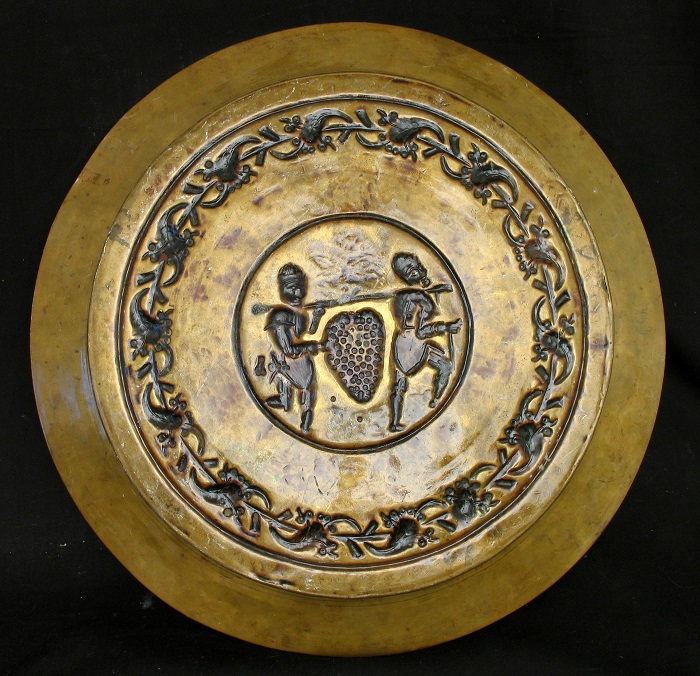
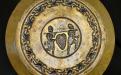
2. Shallow bowl with “Messengers from Canaan” composition, 17th – 18th centuries. The reverse side [KPL-M-7928]
The text was prepared by Olena Serhii, senior research associate
Research Division of the Artistic Heritage of the National Preserve “Kyiv-Pechersk Lavra”
/socialmedia/icons/levelten/glossy/32x32/youtube.png)
/socialmedia/icons/levelten/glossy/32x32/facebook.png)
/socialmedia/icons/levelten/glossy/32x32/twitter.png)